
Sophie Schubakoff (b. 1984) is a Finnish contemporary artist and painter based in Helsinki. She earned a Master of Fine Arts degree from the Academy of Fine Arts in 2011 and has been working as a professional artist for over a decade.
Schubakoff works primarily with acrylic paint and canvas. Water lies at the heart of her artistic practice, serving as both a visual and symbolic language. Her paintings explore memory, emotion, perception, and the relationship between humanity and nature, blending realism with surreal and dreamlike elements.
Schubakoff’s work has been exhibited in Finland and internationally, including in New York, Monaco, Abu Dhabi, Paris, Florence, and Barcelona. She has received grants and awards for her work.
…
RELEVANCE
What makes an image meaningful?
Relevance appears to be something we recognize intuitively, yet it is never a quality that exists entirely in isolation. It emerges from attention, context, recognition, and time. Something becomes relevant because we look at it, speak of it, remember it, and preserve it. Conversely, what fades from view may begin to inhabit an uncertain liminal space between significance and oblivion.
This series of works arises precisely from this uncertainty.
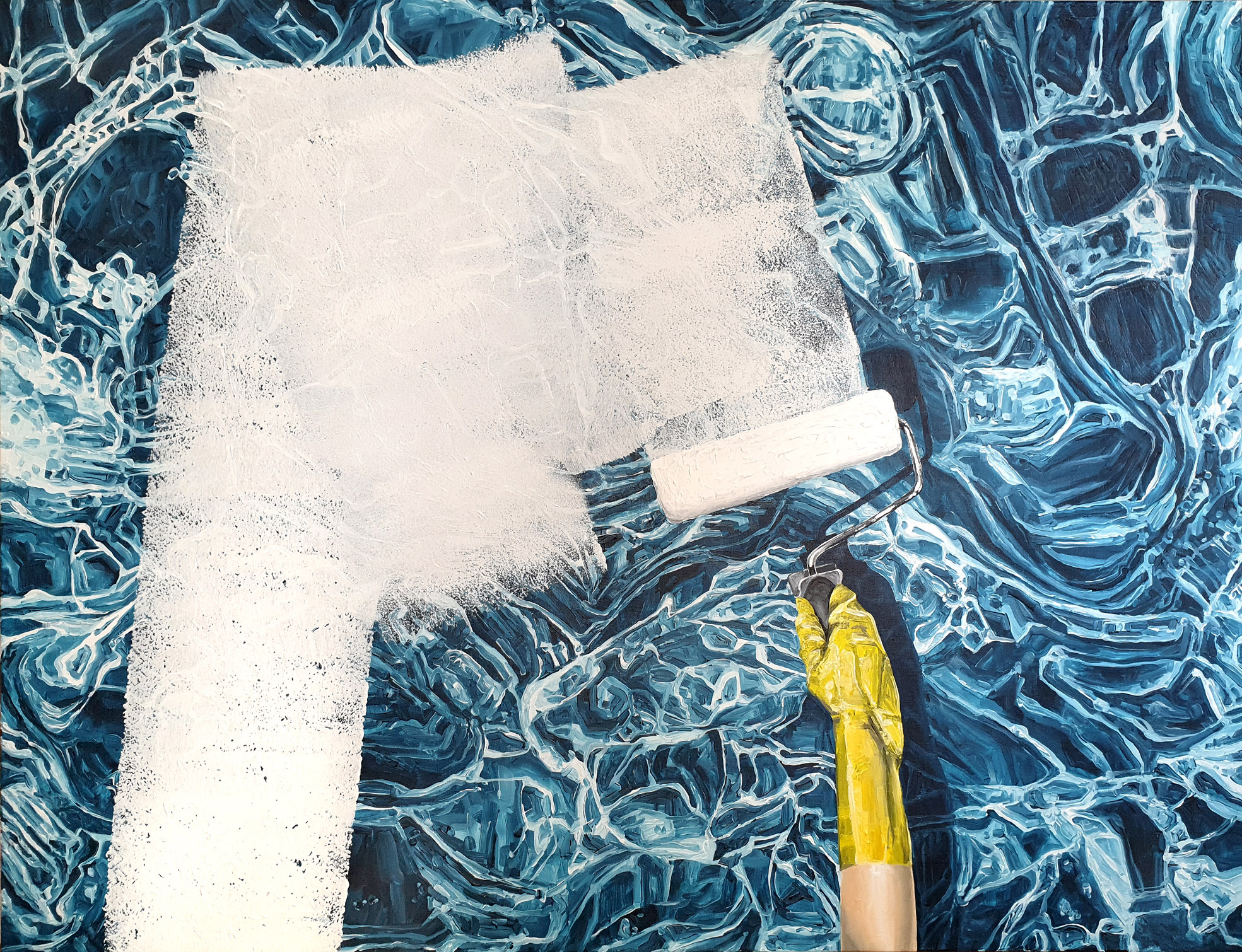
Water serves as the starting point for each piece—both as an image and as a metaphor: flowing, reflective, and constantly shifting. It alludes to a surface that can never be fully arrested or defined—a state where things are simultaneously visible and hidden. Against this instability, white paint enters the scene as an interruption—a gesture that conceals, erases, and transforms.
Covering an image that has already been created is, by nature, a contradictory act. The artist becomes simultaneously creator and eraser, and the work poses the question: can destruction itself become a form of creation? What happens to an image when it is no longer fully accessible to the eye? Does obscuring it diminish its significance, or does the knowledge of what lies beneath the surface give rise to a different kind of presence?
The physical gestures within the works oscillate between proximity and distance. The hand meets its own image directly—almost tenderly—whereas the roller brings with it a more purposeful, impersonal gesture of painting white. The difference lies not merely in the painting techniques, but in the differing attitudes toward what already exists: negotiation and refusal, hesitation and certainty, attachment and indifference.
The word “RELEVANT,” recurring across the surfaces of the works, gradually takes on a paradoxical quality. It promises significance while simultaneously obstructing visibility; it demands attention while preventing the viewer from seeing what lies beneath. Relevance becomes, at once, a declaration and a means of concealment.
In doing so, the works call into question the relationship between becoming visible and becoming valuable.
Yet invisibility does not necessarily imply absence.
Beneath the white surface, the water remains.
The obscured image has not ceased to exist. It has become inaccessible, transformed, and dependent on the viewer’s awareness of what might still lie beneath the surface. Thus, the act of obscuring does not resolve the question of relevance—it renders the question visible.
Perhaps relevance is not a quality an artwork possesses.
Perhaps it is a relationship that constantly emerges between looking and looking away, remembering and forgetting, revealing and concealing.
These paintings continue to exist within this tension. They do not ask what is relevant, but rather who decides—and what becomes of everything we choose not to see?
Artwork: Relevant I, acrylic painting, 92x120cm, 2026